20 minutes
Managing Overtime in Hubstaff
Create daily or weekly overtime policies to pay members at a higher rate when they work beyond a set number of hours. Hubstaff calculates overtime automatically from each member’s tracked time and pay rate, so you don’t need to adjust payroll by hand.
This guide covers how to create, edit, and archive overtime policies, what notifications to expect, and where overtime appears in Hubstaff.
Overtime policy types
Hubstaff offers two types of overtime policies. Each has its own hour threshold and pay rate multiplier, which you can customize to fit your needs.
| Detail | Daily policy | Weekly policy |
|---|---|---|
| Overtime starts when | A member’s tracked time passes the daily threshold on one day | A member’s tracked time passes the weekly threshold in one work week |
| Threshold resets | Every day | At the start of each work week |
| Notifications available | When overtime starts | 1 hour before overtime starts, and when overtime starts |
Hubstaff calculates overtime based on your organization’s time zone. Your work week starts on the day you set under Settings > Organization > Company information. See Organization Settings in Hubstaff for details.
Daily overtime example
Let’s say a daily policy has an 8-hour threshold. A member tracks the following hours:
- Monday: 7 hours, so 0 hours of overtime
- Tuesday: 9 hours, so 1 hour of overtime
- Wednesday: 12 hours, so 4 hours of overtime
The daily total resets each day, so Monday’s hours don’t affect Tuesday.
Weekly overtime example
Let’s say a weekly policy has a 40-hour threshold. A member tracks 42 hours in the work week, so 2 hours are weekly overtime.
Creating an overtime policy
Step 1
Go to Settings > Policies > Overtime.
Step 2
Click Create policy.
Step 3
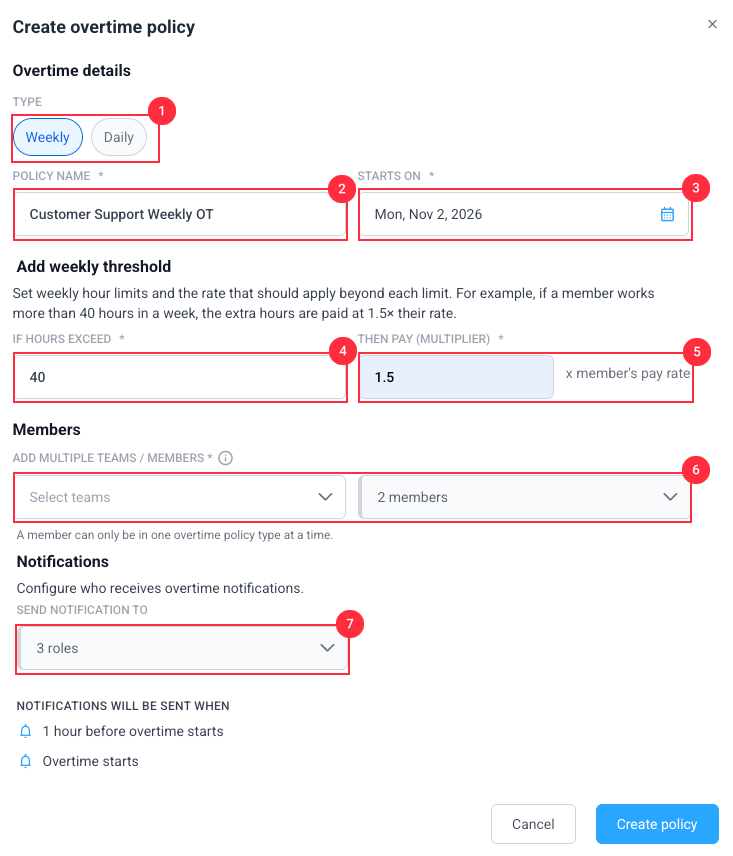
In the Create overtime policy dialog, complete the following fields:
- Type: Select Weekly or Daily. You can’t change the type after you save the policy.
- Policy name: Enter a name that tells you who the policy covers, such as Warehouse daily overtime.
- Starts on: Choose the date the policy takes effect. Hubstaff calculates overtime from this date forward and doesn’t recalculate past pay periods. Daily policies can start as early as tomorrow. Weekly policies start in the next work week.
- If hours exceed: Enter the threshold in hours. Overtime starts after a member passes this number of hours in a day (daily) or in a work week (weekly).
- Then pay (multiplier): Enter the rate multiplier for overtime hours. For example, 1.5 pays overtime hours at 1.5 times the member’s pay rate.
- Teams and/or Members: Select teams, members, or both. Selecting a team adds all of its members. Members need a pay rate before you can add them to an overtime policy.
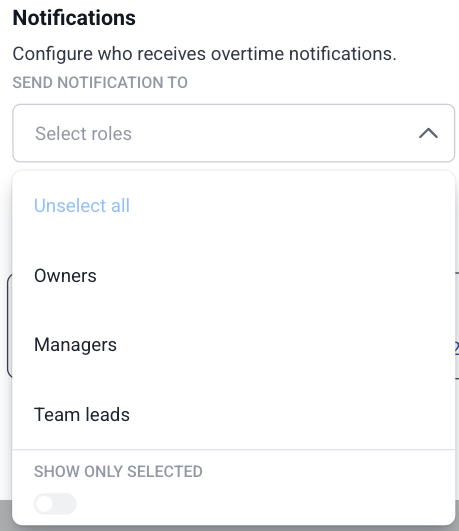
- Send notification to: Choose which roles or members receive overtime notifications. The dialog lists when notifications are sent for the type you selected.
Step 4
Click Create policy. Hubstaff adds the policy to your list and calculates overtime from the start date.
Using daily and weekly policies together
You can assign a member to one daily policy and one weekly policy. Hubstaff never pays the same hour as overtime twice, and each hour of overtime appears under its policy type, Daily OT or Weekly OT.
These examples use a daily policy with an 8-hour threshold and a weekly policy with a 40-hour threshold.
- Only the weekly threshold is passed: A member tracks 8 hours Monday through Friday and 4 hours Saturday, for 44 hours. No single day passes 8 hours, so the member has 4 hours of weekly overtime.
- Only the daily threshold is passed: A member tracks 12 hours Monday, 8 hours Tuesday through Thursday, and 3 hours Friday, for 39 hours. The member has 4 hours of daily overtime, and no weekly overtime because the total stays under 40.
When both policies cover the same hour
Hubstaff calculates daily overtime first. The weekly threshold then applies to the hours that are left, so an hour is only ever paid as overtime once.
For example, a week with 8, 8, 8, 8, and 9 hours worked will get 1 hour of daily overtime.
Overtime policy status
The Overtime policies page lists each policy with its type, summary, number of members, notification setting, status, and date created. Use the Active, Scheduled, Archived, and All filters above the table to narrow the list.
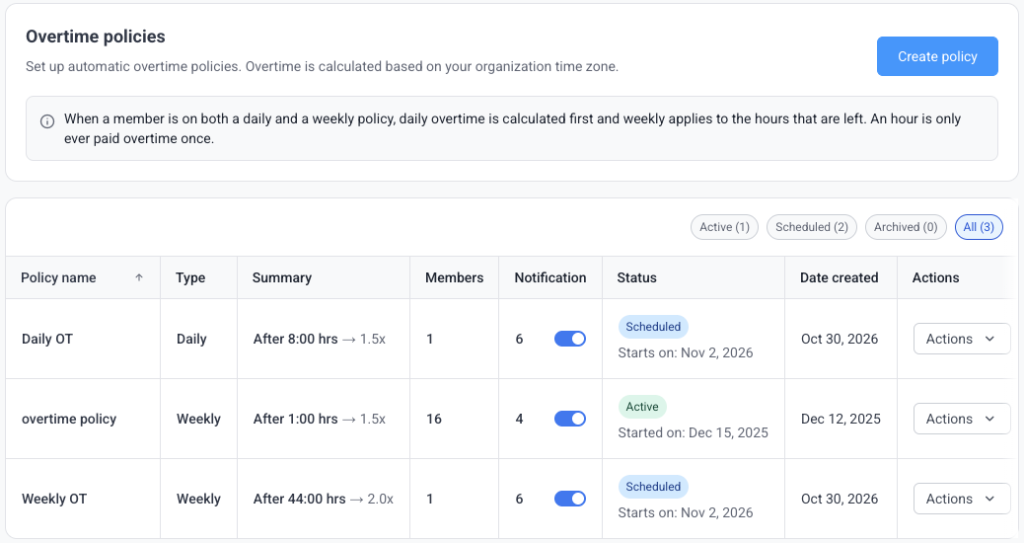
The Status column shows one of the following:
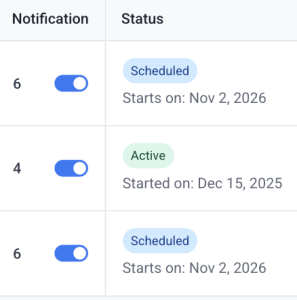
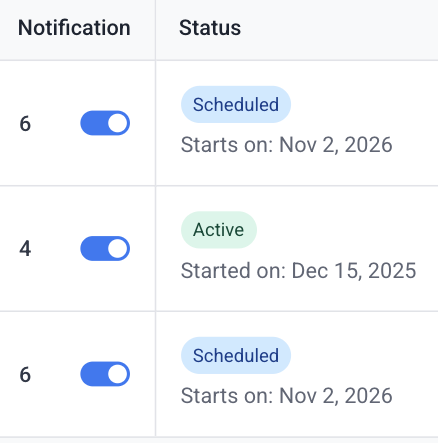
- Scheduled means the policy has not started and no active time is tracked.
- Active means the policy is operational and time is tracked within the policy.
- Archived means the policy has been deactivated. Select the Archived filter to see archived policies.
Editing, archiving, and restoring a policy
Use the Actions button in a policy’s row to manage it. The available actions depend on the policy’s status.
Edit a policy
Active and scheduled policies can be edited.
Step 1
Go to Settings > Policies > Overtime.
Step 2
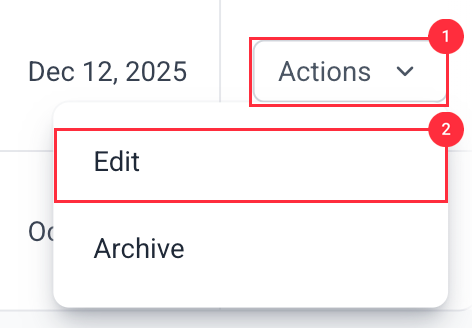
In the policy’s row, click Actions, then Edit policy.
Step 3
Update the policy name, start date, threshold, multiplier, members, or notification settings, then click Save.
You can’t change a policy’s type after you create it. To move a member from one policy to another, edit the policy you’re moving them to. Hubstaff shows a warning before it replaces the member’s current policy.
Changes to a policy’s members take effect at the start of your organization’s next work week. If a member you add has no pay rate, Hubstaff lists them in the dialog and blocks the save until you set one. Click a member’s name to set their pay rate.
Archive a policy
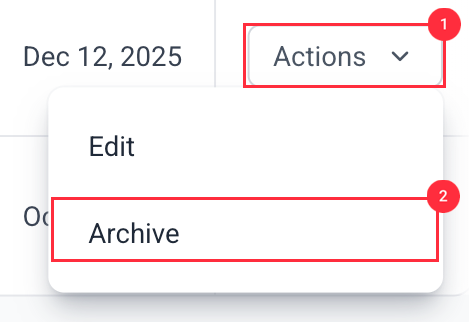
Click Actions, then Archive, and confirm in the dialog.
The policy stops applying immediately and moves to the Archived filter.
Restore or view an archived policy
Select the Archived filter, then click Actions for the policy.
- Restore returns the policy to Active after you confirm.
- View opens the policy in read-only mode. You can only edit the policy name.
Overtime notifications
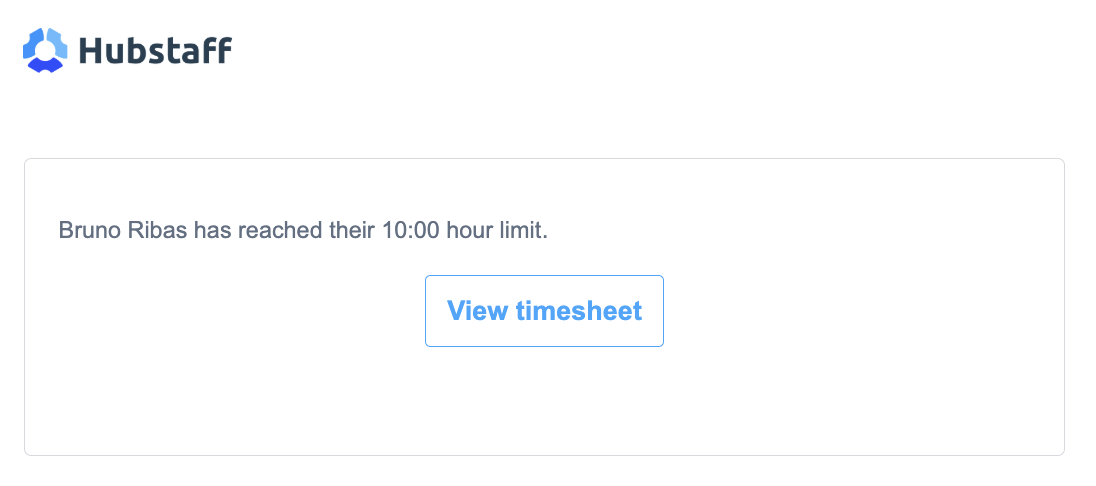
Hubstaff emails the people you choose when members reach overtime. Each policy has its own notification settings:
- Daily policies send a notification when a member’s overtime starts. Because the daily threshold resets each day, the notification can trigger once per day.
- Weekly policies send a notification 1 hour before overtime starts and another when overtime starts.
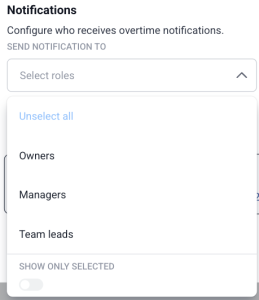
- Recipients: Choose roles (org owners, managers, and/or team leads) or specific members under Send notification to when you create or edit the policy.
- Turn notifications on or off: Use the toggle in the Notification column of the policies list.
User email notification example

Manager email notification example
Where is overtime visible?
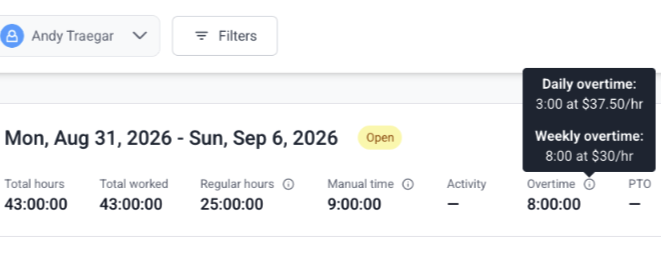
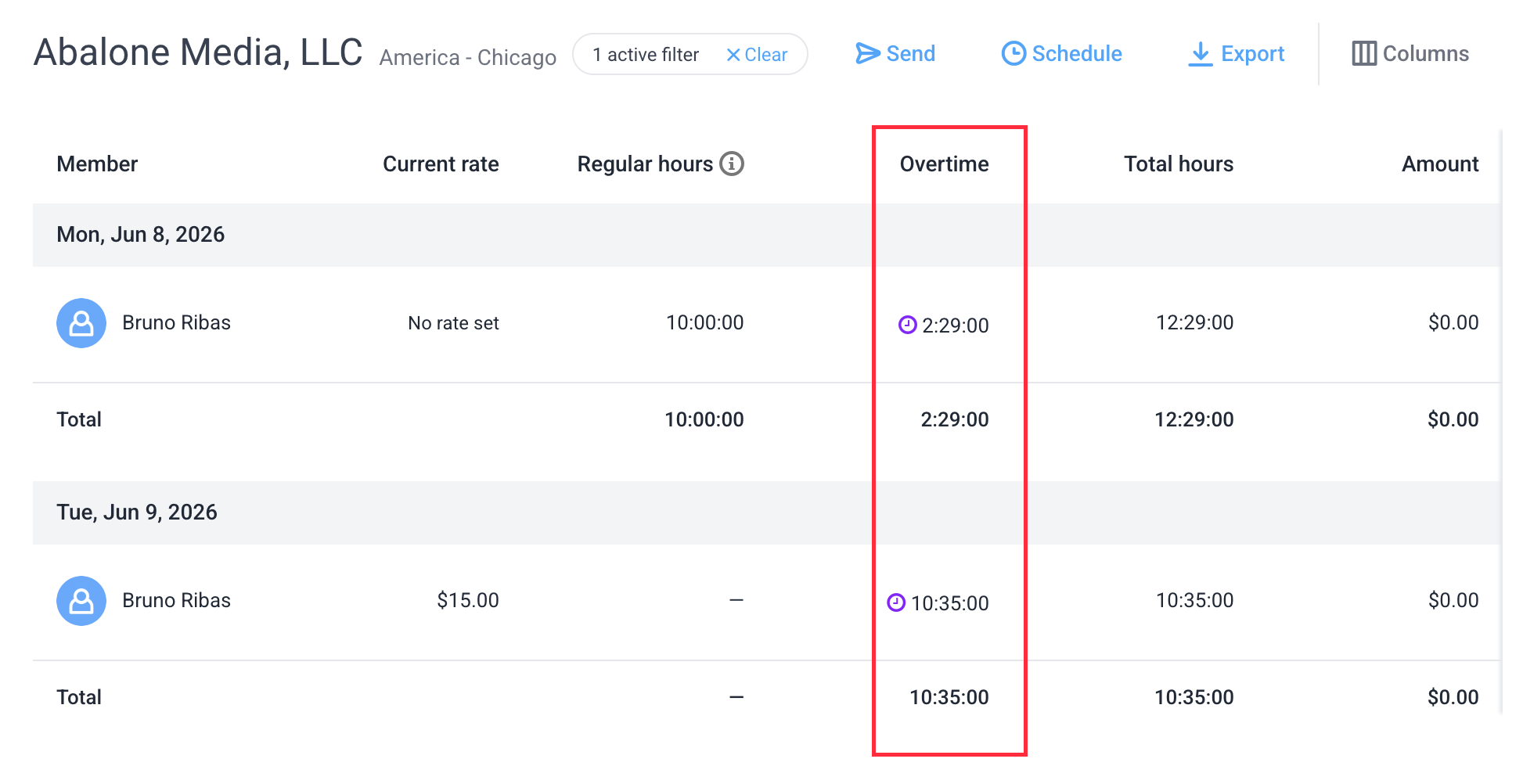
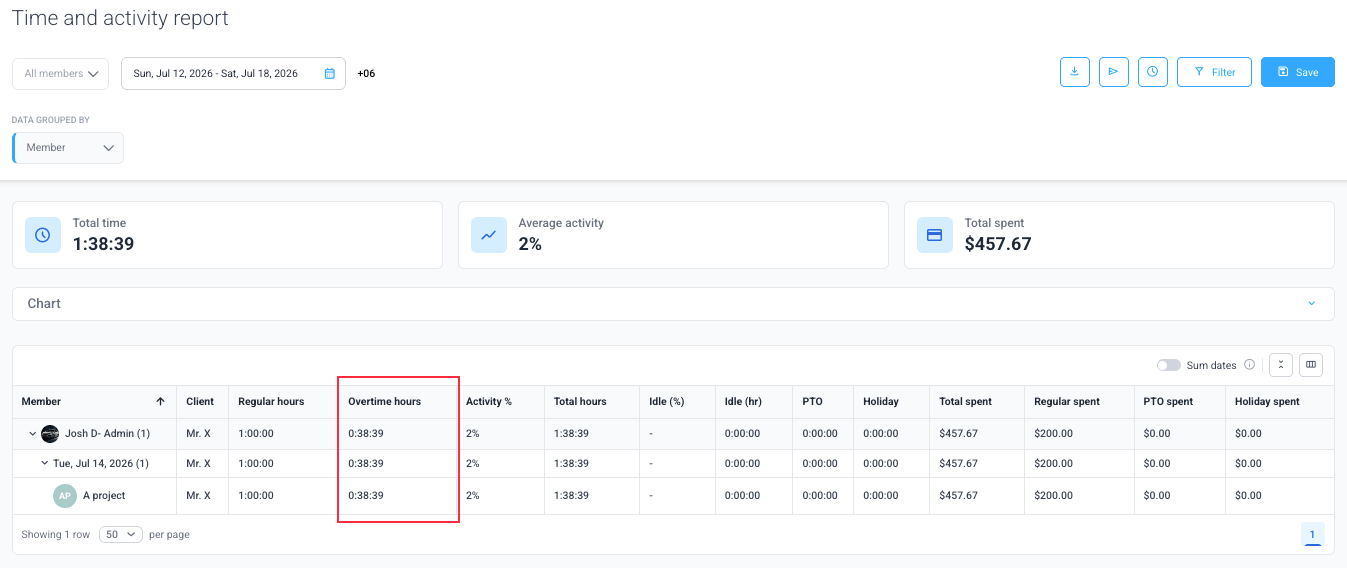
Hubstaff shows overtime by policy type, so you can tell whether hours came from a daily or a weekly policy. Regular hours, daily overtime, and weekly overtime always add up to the member’s total tracked hours. The Amounts owed, Time and activity, and Daily Totals reports include daily overtime in their overtime totals.
Timesheet approvals
On each day, the timesheet shows an overtime indicator when a member passes the daily threshold. Weekly overtime can appear later in the week, once the member passes the weekly threshold. Overtime is labeled Daily Overtime or Weekly Overtime.
Navigate to Timesheets > Approvals.
Amounts owed report
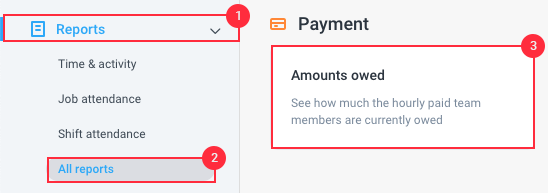
Navigate to Reports > Amounts owed:
Time and activity report
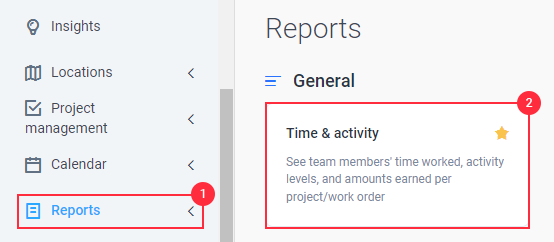
Navigate to Reports >Time and activity report:
Daily Totals
Navigate to Reports> Daily Totals:
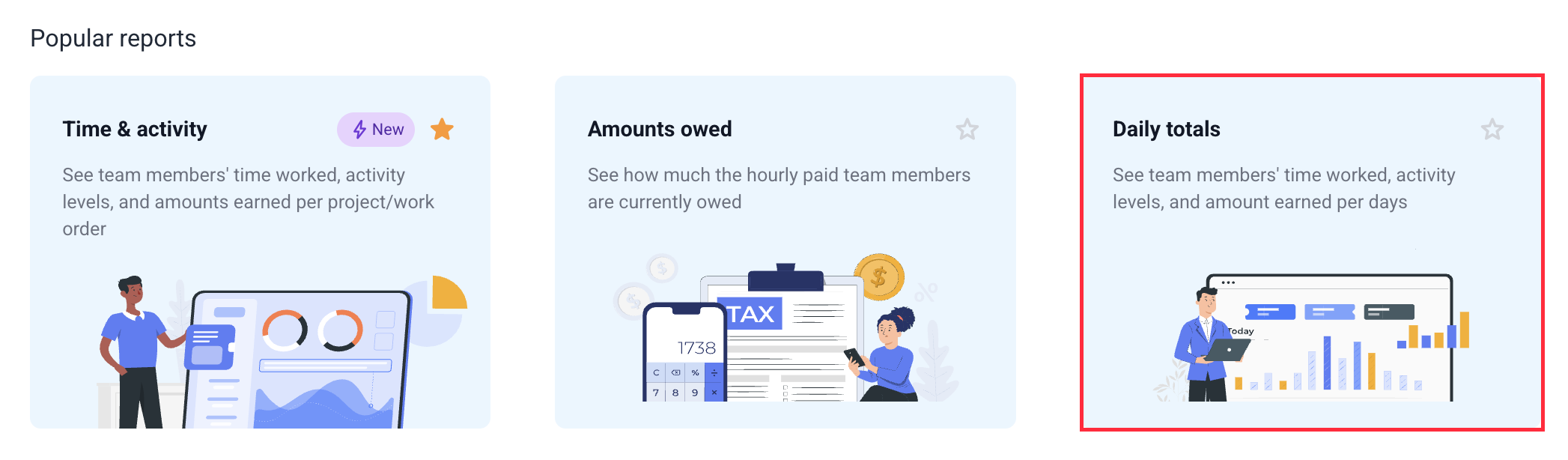

Note: The Overtime column only appears when there is an overtime policy active.
Payments
Navigate to Financials > Create payments > Approved timesheets
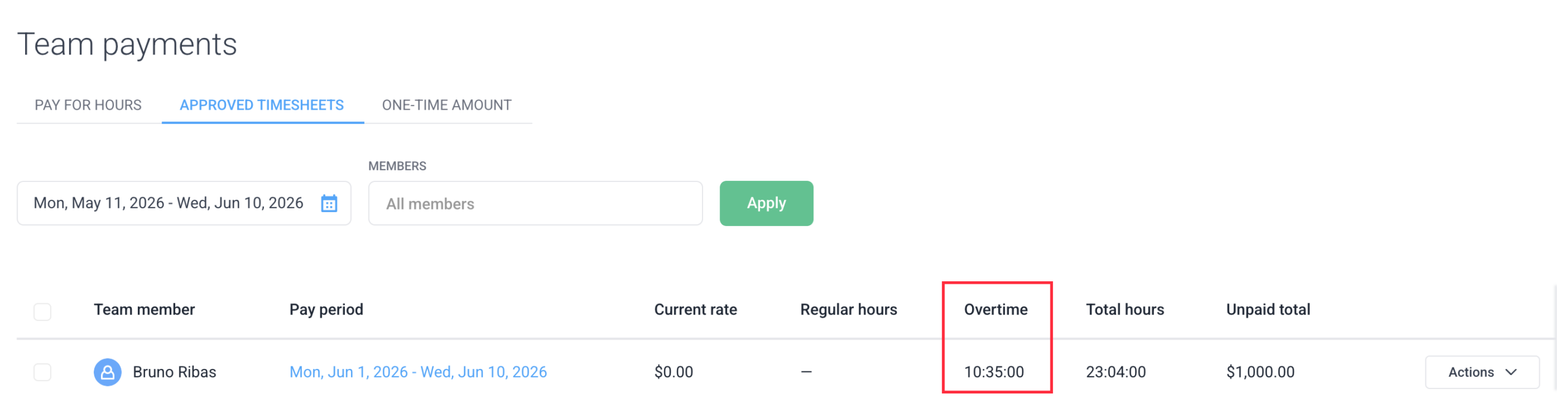
Payments include both daily and weekly overtime.
Dashboard
The Amounts owed widget includes daily and weekly overtime in its total. Hover the Unpaid amount cell to see the breakdown by policy type.
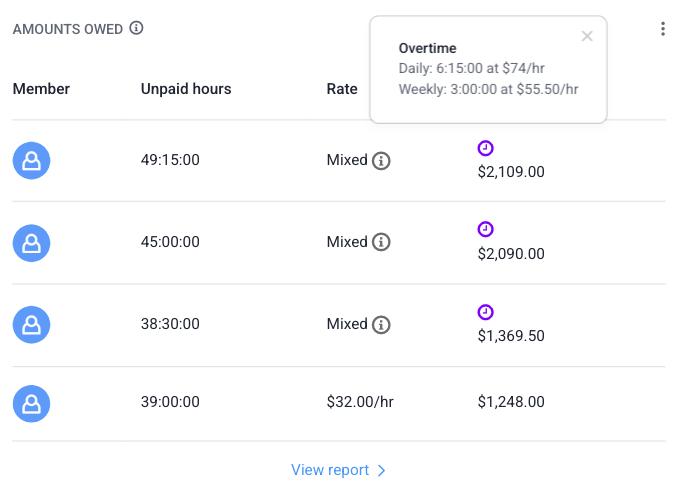
Members page and member profiles
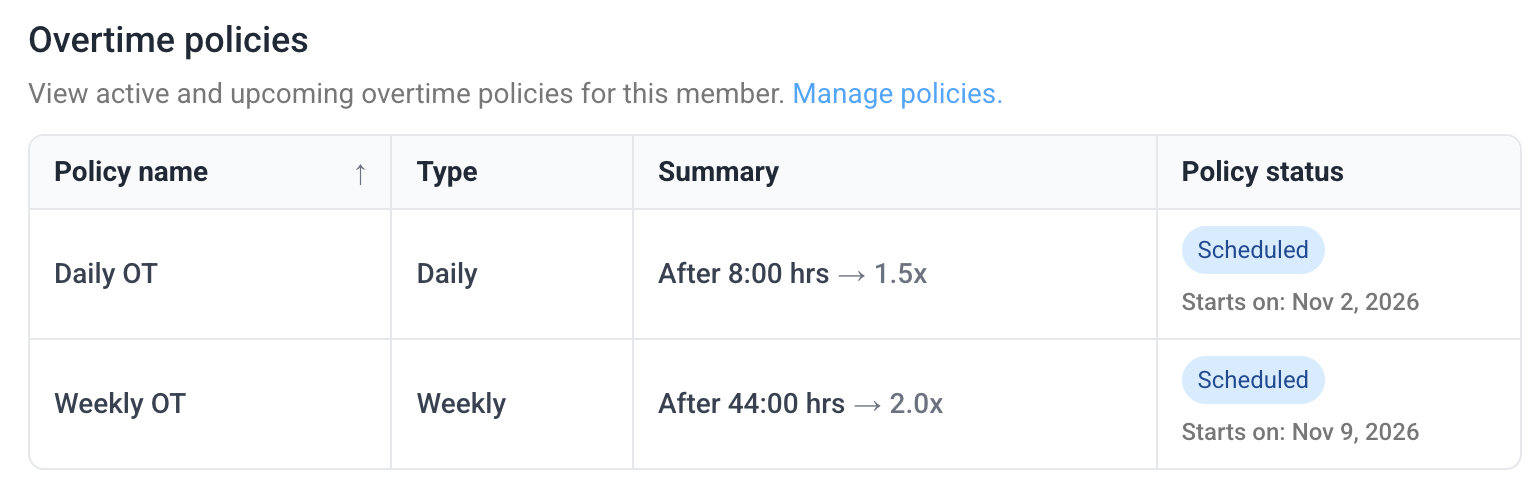
To see which overtime policies apply to a member, go to Settings > Members and select the member’s profile. Open the Work time & limits tab, then find the Overtime policies section. Here, you’ll see the member’s assigned policies and a link to the Overtime policies page.