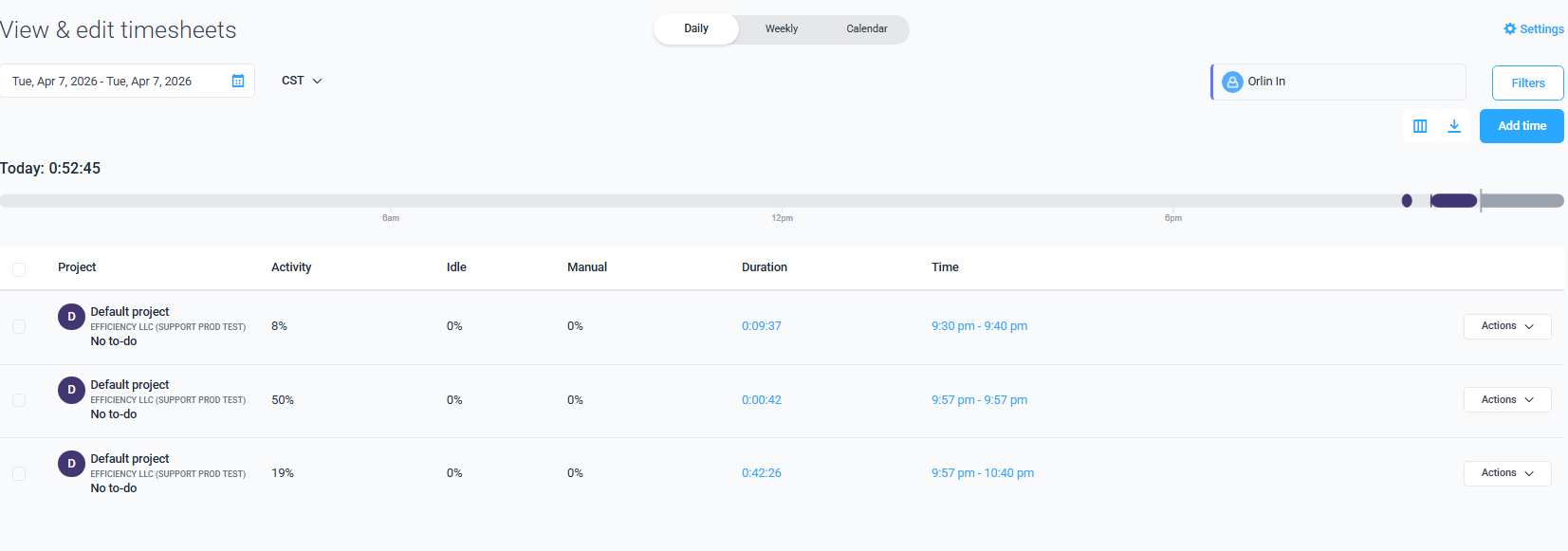
22 minutes
Silent App Setup JumpCloud (macOS)
The Hubstaff Silent App enables organizations to monitor team productivity on corporate-managed Mac devices. Once deployed via JumpCloud, it runs entirely in the background and remains invisible to the end user, with no installation prompts, no visible interface, and no user interaction required.
ℹ️ Before deploying at scale: Configure Ignored Usernames under Settings → Silent app → Ignored usernames to prevent IT admin accounts, LAPS accounts, and service accounts from being auto-provisioned as tracked members.
For a complete deployment hub including guides, troubleshooting, and advanced configuration, visit the Silent App Deployment Center.
Screen Recording is a global macOS permission. Due to Apple’s privacy controls, it cannot be granted silently, and it is not automatable via a .mobileconfig / PPPC profile and cannot be pre-approved through an MDM profile on the user’s behalf. Set this expectation with end users before rollout.
Your options:
- Manual acceptance per device: the user approves the prompt once via System Settings > Privacy & Security > Screen Recording. Straightforward for small fleets or pilot rollouts, but cannot be skipped or delegated remotely.
- Disable screenshot capture: if a fully silent install is required, disable screenshots in Hubstaff Settings for macOS users to avoid the prompt entirely.
Heads up: macOS updates can silently revoke this permission, which typically surfaces as missing screenshots or URLs. After major OS updates, have users re-check System Settings > Privacy & Security and confirm Hubstaff is still listed and enabled.
Prerequisites
Make sure you have the following in place:
- A JumpCloud account with Apple MDM configured. See Set Up Apple MDM.
- Target devices enrolled in JumpCloud MDM. See Choose an MDM Enrollment Method.
- Hubstaff paid plan with the Silent app add-on enabled.
- Target devices running macOS 12.0 (Monterey) or newer.
- The .pkg installer and .mobileconfig files downloaded from Hubstaff (covered in the steps below).
Suppress background item notifications
On macOS Ventura (13) and newer, macOS displays a notification whenever an application running in the background is first detected. This must be configured before deploying the installer, uploading this profile first ensures end users never see any indication that the Silent app is running.
Click on the Silent app > Setup guide page. 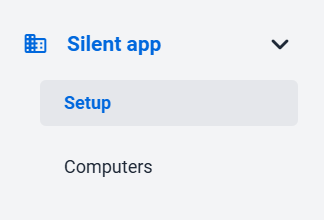
Choose your operating system: 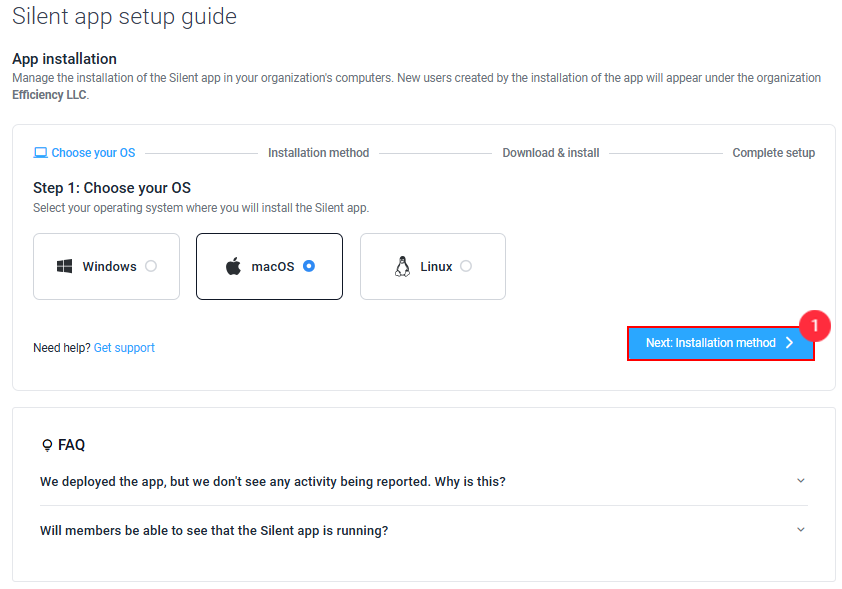
Choose Group installs as your installation method. Download the .mobileconfig file. 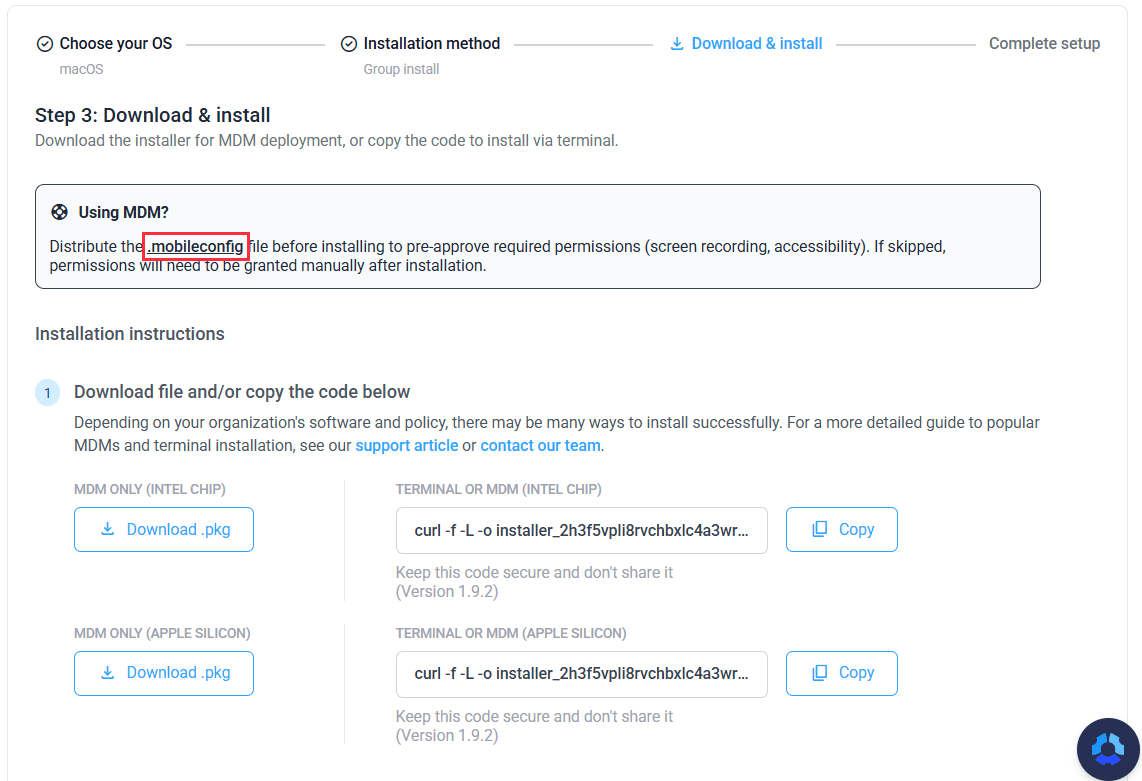
Create and upload the PPPC profile:
- Log in to the JumpCloud Admin Portal.
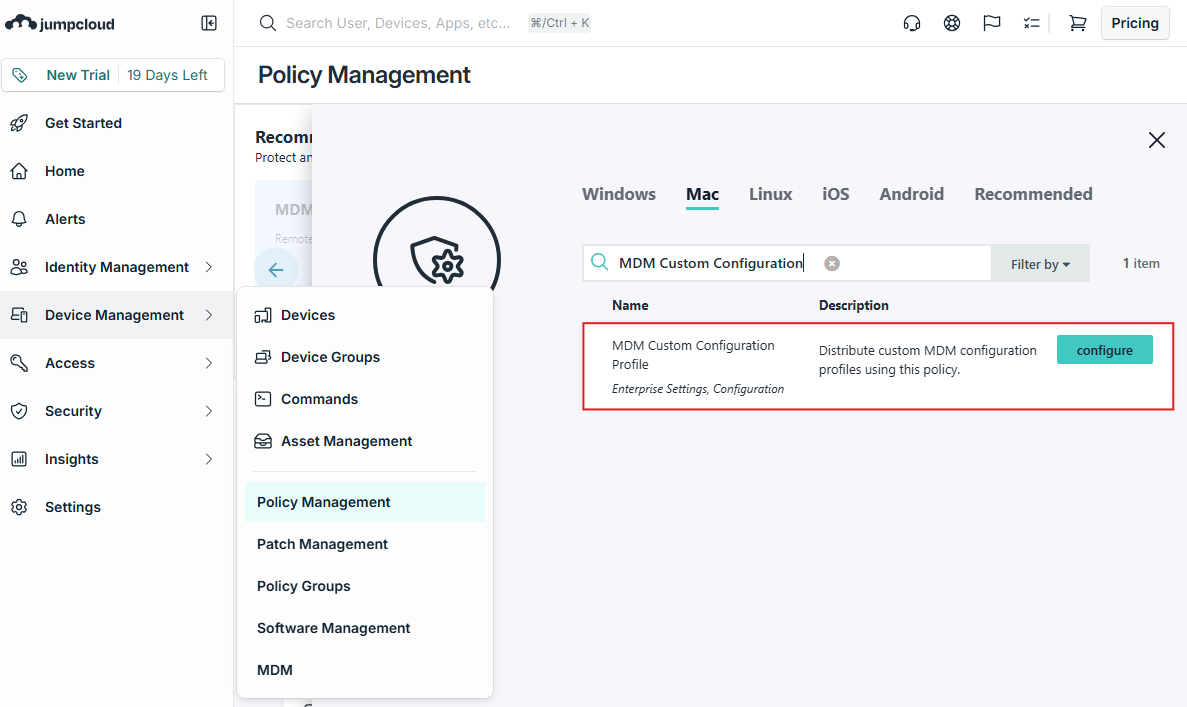
- Go to Device Management > Policy Management.
- In the All tab, click (+).
- On the New Policy panel, select the Mac tab.
- Select MDM Custom Configuration Profile from the list, then click Configure.
- Under Settings, click Upload file and select the .mobileconfig file.
- Give the policy a recognizable name, e.g. Hubstaff Silent Background Notifications or Hubstaff Silent PPPC.
- Select the Device Groups tab and assign the policy to your target device group.
- Click Save.
Download the Hubstaff Silent app installer
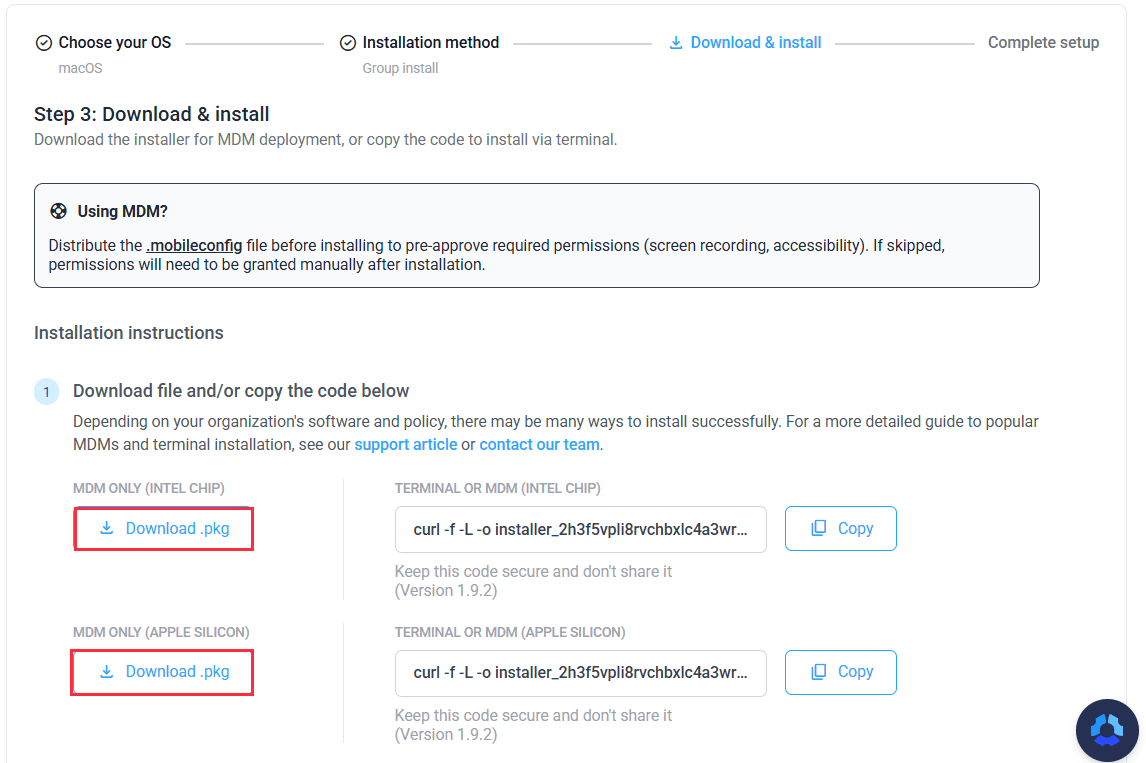
In the Hubstaff web app, click Silent app > Setup guide > macOS > Group install > Download & install
ℹ️ Apple Silicon (M1, M2, M3, M4, M5): Your Mac uses Apple’s own chip. Download the arm64 (Apple Silicon) version of the Hubstaff Silent app installer.
Deploy the Hubstaff Silent app package via JumpCloud
JumpCloud offers three ways to deploy the .pkg to managed Mac devices. The method we recommend for deploying the Silent app is: Commands (CURL):
- Commands (curl) – Recommended: Run a bash script via JumpCloud Commands using the curl install command provided in Hubstaff. Suitable when MDM-based software management is not available or you prefer a script-driven approach.
- Self-Hosted: Host the .pkg at a publicly accessible, TLS-secured URL and point JumpCloud to it.
- JumpCloud Private Repository: Upload the .pkg directly through the Admin Portal (no external hosting needed).
Option A: Commands (curl script) – Recommended
Use this option if you prefer a script-driven deployment, additionally, with this method we ensure the installer file is not modified at any point. JumpCloud Commands run bash scripts across device groups via the JumpCloud agent.
- In the Hubstaff web app, go to Silent app > Setup guide > macOS > Group install and copy the provided curl install command.
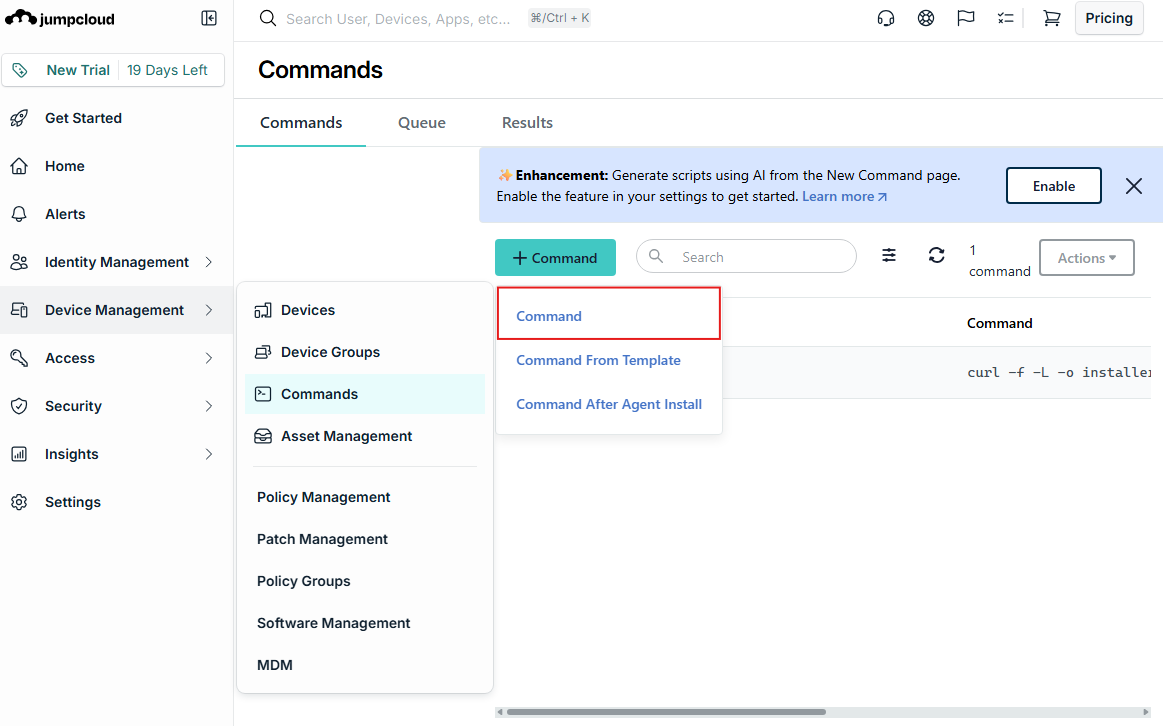
- In the JumpCloud Admin Portal, go to Device Management > Commands.
- Click + Command, then select Command.
- In the Details tab, enter a name for the command (e.g. Install Hubstaff Silent).
- For Type, select Mac.
- In the command script field, paste the curl install command copied from Hubstaff. It will follow this pattern:
#!/bin/bash
curl -f -L -o <Your-installer-file-name>.pkg 'https://app.hubstaff.com/download/deploy/osx/pkg/release?architecture=arm64' ; sudo installer -pkg <Your-installer-file-name>.pkg -target / ; rm ./<Your-installer-file-name>.pkg/- Under Devices or Device Groups, select the target group for deployment.
- Click Save.
- To run the command immediately, return to Device Management > Commands, locate the command, and click Run.
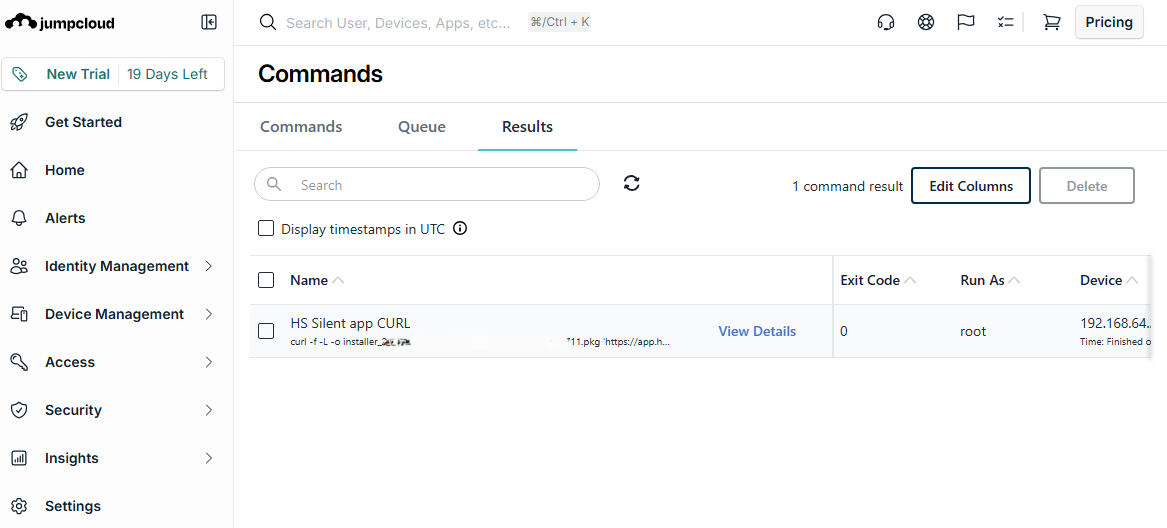
Command results are available under Device Management > Commands > Results. Click View Details next to any entry to see the stdout, stderr, and exit code for each device.
Option B: Self-Hosted package
- Upload the .pkg file to a publicly accessible, TLS-secured host (e.g. an Amazon S3 bucket with a static URL).
- In the Admin Portal, go to Device Management > Software Management.
- Select the Apple tab, then click (+) Add New and select Self-Hosted.
- On the Details tab, enter a unique display name under Software Description.
- Paste the direct package URL into Software Package URL.
- Click Validate. Once validated, the Software Name and Software Version fields populate automatically.
- Select the Device Groups tab and assign the app to your target group.
- Click Save, then Save again to confirm.
Option C: JumpCloud Private Repository
⚠️ JumpCloud Private Repository renames uploaded .pkg files, JumpCloud’s backend processing may rename the installer file after upload, which can break the Hubstaff Silent App installation process. To avoid this, use the command (CURL) or self-hosted URL method instead (e.g., an Amazon S3 bucket or similar static file host), which preserves the original filename throughout deployment.
- In the Admin Portal, go to Device Management > Software Management.
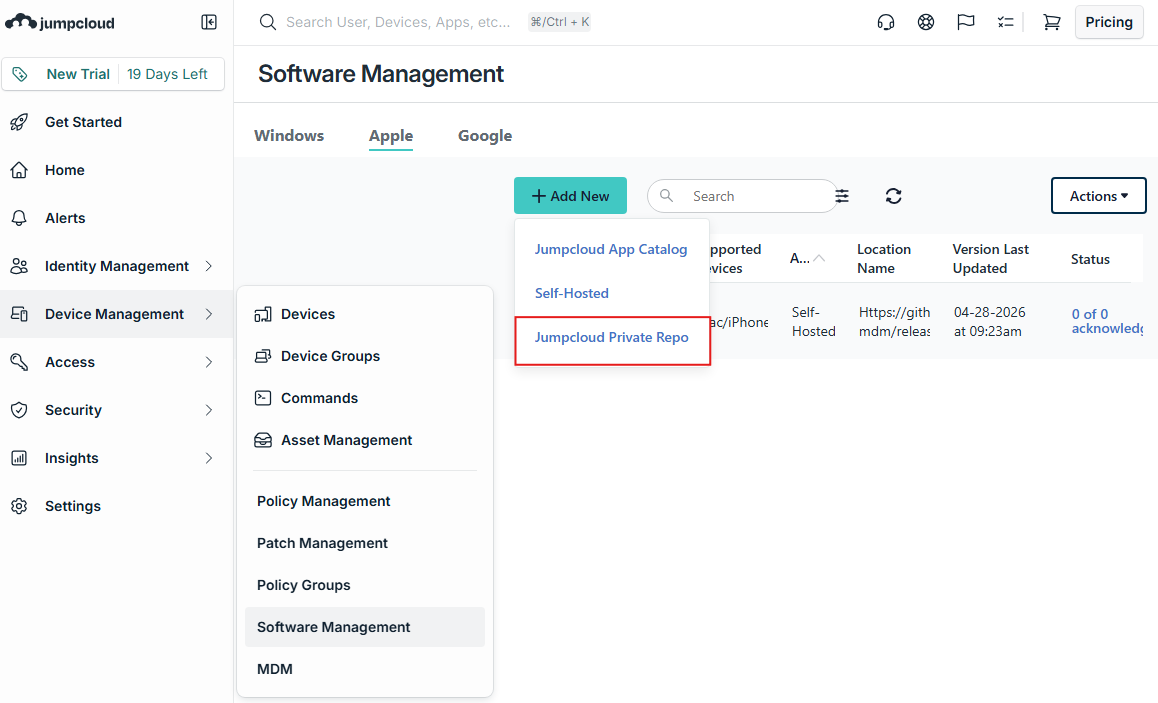
- Select the Apple tab, then click (+) Add New.
- Select JumpCloud Private Repository.
- Under Application Name, enter a name (e.g. Hubstaff Silent or Confidential).
- Under Upload File, drag and drop the .pkg file or click Choose a File to browse for it. Only .pkg file types are supported for Apple devices.
- Click Upload. An upload progress bar appears, wait for the File uploaded successfully confirmation before proceeding.
- Once processing completes, select the Device Groups tab and assign the app to your target group.
- Click Save, then Save again to confirm deployment.
Monitor the Silent app deployment
Monitor – JumpCloud Admin Portal
After assigning the app to a device group, deployment status is visible directly from the app’s record. In the Admin Portal, go to Device Management > Software Management > Apple, select the Hubstaff Silent app, then click the Status tab to see a per-device breakdown of install states. If a device shows as pending for longer than expected, see Troubleshooting below.
Monitor – Hubstaff dashboard
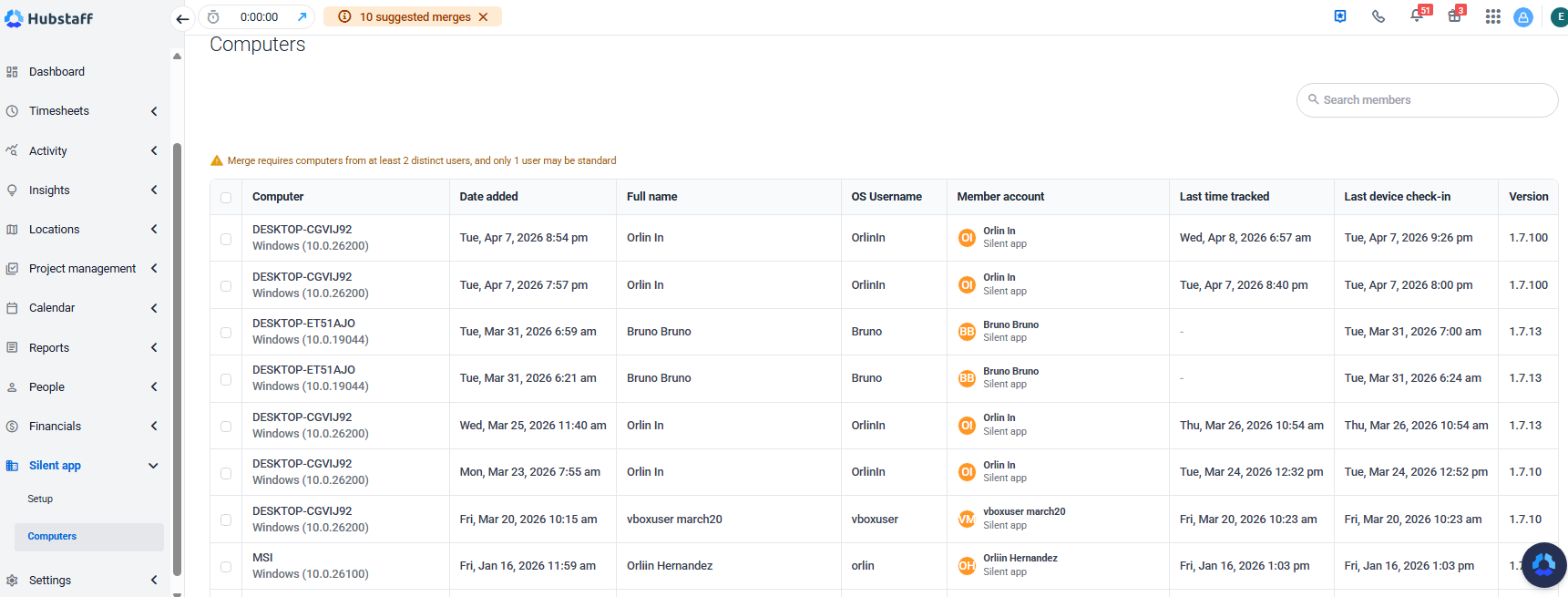
As soon as the installer runs successfully on a device, that machine registers in Hubstaff and begins tracking. Navigate to Silent app > Computers and filter by Date added or Last time tracked to confirm new devices are checking in.
Troubleshooting deployment
Check whether the app bundle is present
Run the following in Terminal to confirm the app was installed to the expected location:
ls /Applications/HubstaffSilent.appIf the path exists, the package installed successfully. If you get a “No such file or directory” error, the installer has not run yet, check the Status tab in JumpCloud’s Software Management for errors.
Confirm the package receipt is registered with macOS
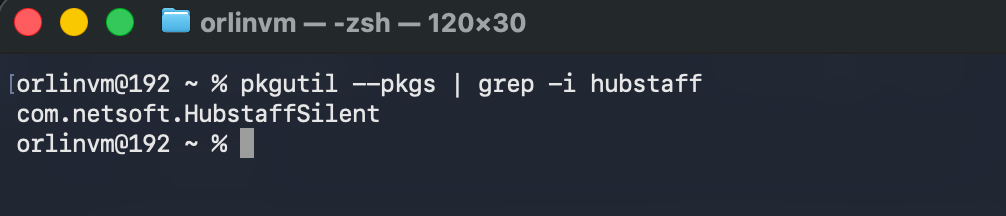
macOS logs a receipt for every installed package. Query it directly to verify the install was recorded:
pkgutil --pkgs | grep -i hubstaffA matching identifier confirms macOS recorded the installation. No output means the package either never ran or failed partway through.
Check whether the process is active
If the app is installed but you’re not seeing data in Hubstaff, verify the process launched:
pgrep -l HubstaffSilentA PID and process name will appear if it’s running. No output means the process hasn’t started, sign out and back in to the macOS session, or restart the device to trigger it.
Device not receiving the package
JumpCloud delivers packages via MDM commands on the next device check-in. If a device hasn’t received the app yet, confirm the device is a member of the assigned device group and that its MDM enrollment is active. You can verify enrollment status in the Admin Portal under Device Management > Devices, the device’s MDM column should show as enrolled. If it doesn’t, the device may need to be re-enrolled before it can receive software deployments.
Package URL validation fails (Self-Hosted only)
If JumpCloud fails to validate the package URL, confirm the following:
- The URL uses HTTPS (TLS is required, HTTP is not supported).
- The file is publicly accessible without authentication.
- The URL points directly to the .pkg file and does not redirect to a different version.
- Google Drive links are not supported, use S3, GCS, or another static file host.
Following installation
- Time tracking should begin immediately. Data will be visible in the Hubstaff web app within 10–15 minutes of installation completing.
- If tracking data is not reflected after 15 minutes, restart the Hubstaff Silent process by doing one of the following:
- Sign out and back in to the macOS session.
- Restart the device.